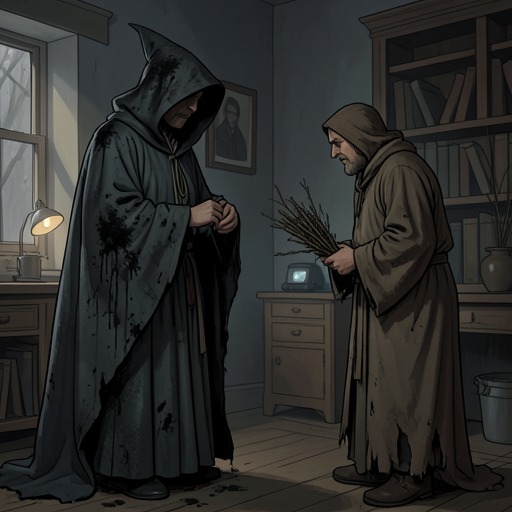
Babbitty performs magic for the king
The Tales of Beedle the BardBabbitty Rabbitty’s hidden magical assistance enables a charlatan to stage a convincing display of magic for a foolish King who cannot perform it himself. From inside a bush, Babbitty makes a noblewoman’s hat disappear and the King’s horse rise into the air, while the audience applauds the King. The arrangement turns real magical skill into a public deception: the King receives the admiration, but Babbitty supplies the power.
Discovery and Arrangement
After the King threatens the charlatan with punishment if he cannot help him perform magic before the court, the charlatan searches for a way out of the danger. Looking through the window of Babbitty Rabbitty’s house, he sees her polishing a wand while the King’s sheets wash themselves in a wooden tub. He recognizes that she is a genuine witch and concludes that she can solve the predicament.
The charlatan approaches Babbitty with a threat: unless she helps, he will denounce her to the King. Babbitty nevertheless agrees to assist. The charlatan’s plan is for her to hide in a bush during the King’s display and cast each spell without the King’s knowledge. Her cooperation makes the performance possible, but she identifies a limit the plan has not accounted for: what if the King asks for a spell she cannot perform? The charlatan dismisses the concern, assuring her that her magic exceeds the King’s imagination.
The Public Display
The next morning, the kingdom’s lords and ladies gather in the palace grounds. The King stands on a stage with the charlatan beside him and announces that he will make a noblewoman’s hat disappear. Concealed in a nearby bush, Babbitty points her wand at the hat and vanishes it. The crowd responds with astonishment and applause, and the King enjoys their admiration as though the feat were his own.
The King then points his twig at his horse and declares that he will make it fly. Babbitty again works from her hiding place, raising the horse high into the air. The crowd is more thrilled still, and its approval reinforces the King’s belief that he has successfully demonstrated magic. The repeated structure of the performance—royal announcement, Babbitty’s concealed spell, public acclaim—makes the distinction between the King’s claim and Babbitty’s actual action central to the scene.
Deception and Magical Limits
The King’s performance rests on a mistaken model of magic: he believes that learning incantations and waving a wand can make someone a wizard. In the tale’s accompanying commentary, the King is described as ignorant of the nature of magic and ready to accept the charlatan’s and Babbitty’s implausible explanations. The charlatan’s confidence that Babbitty can meet any demand follows the same error: he treats magic as a resource that can simply be supplied on command, without considering what the King might ask her to do.
Babbitty’s role also connects the episode to the particular risks of magical concealment. Animagi are rare, and achieving perfect, spontaneous transformation from human to animal requires study and practice. Because such an ability can serve disguise or covert activity, the Ministry of Magic requires Animagi to register. The commentary raises the possibility that Babbitty may have been modeled on Lisette de Lapin, a French sorceress convicted of witchcraft in Paris in 1422, though it presents that identification as speculation rather than established fact.
Wider Stakes and Significance
The episode’s public deception unfolds against a longer history of mistrust between magical and non-magical people. Beedle’s original tale of the Hopping Pot preached brotherly love for Muggles, but that message ran against the growing persecution of witches and wizards in early-fifteenth-century Europe. Fear helped widen the separation between the communities, culminating in the International Statute of Wizarding Secrecy in 1689. The tale’s conflict between a Muggle King who covets magic and the witch who must conceal hers belongs to that history of unequal power and mutual suspicion.
Later commentary on Beedle’s work makes the politics of that divide explicit. Lucius Malfoy demanded that a story involving relationships between wizards and Muggles be removed from the Hogwarts library, arguing that it might encourage intermarriage and threaten blood purity. Albus Dumbledore refused, pointing out the hypocrisy of families that concealed Muggles or Muggle-borns in their ancestry while demanding that students be denied works addressing those realities. Those disputes echo the tale’s treatment of magic as a source of power that non-magical authorities may desire, fear, or try to control.
The tale also places Babbitty’s performance beside the limits of magical power. Its commentary notes that the Cruciatus, Imperius, and Avada Kedavra Curses were classified as Unforgivable in 1717, while observing that the story’s threat involving a tree and an axe-like sensation may draw on magical traditions surrounding wand-quality trees and protective curses. In this setting, magic is neither a simple trick nor an unlimited answer: Babbitty can supply the King’s spectacle, but the charlatan’s unexamined confidence leaves the plan vulnerable to a request beyond her ability. Her concealed work thus exposes both the King’s ignorance and the danger of mistaking an impressive performance for mastery.